In the pre-production stage, the storyboard artist takes the scripts and transforms it into a clear visual sequence. Sometimes a scene is described in only one paragraph, the artist needs to punch up it from the sides of story structure and film language (Sony Pictures Animation, 2014). Whenever I watched films, I enjoy observing the good examples of shot design, and record them for reference. It makes me concern the visual storytelling, and have passion for developing the staging and camera movement when I work on storyboards.
How to get into the industry
- Strong Portfolio
When assembling a portfolio, we should consider the career pathway in the future. There are many different boarding styles, and they can vary widely from project to project. Michelle Lam introduced how different the boarding styles apply in TV series and feature films. (mewTripled, 2020)
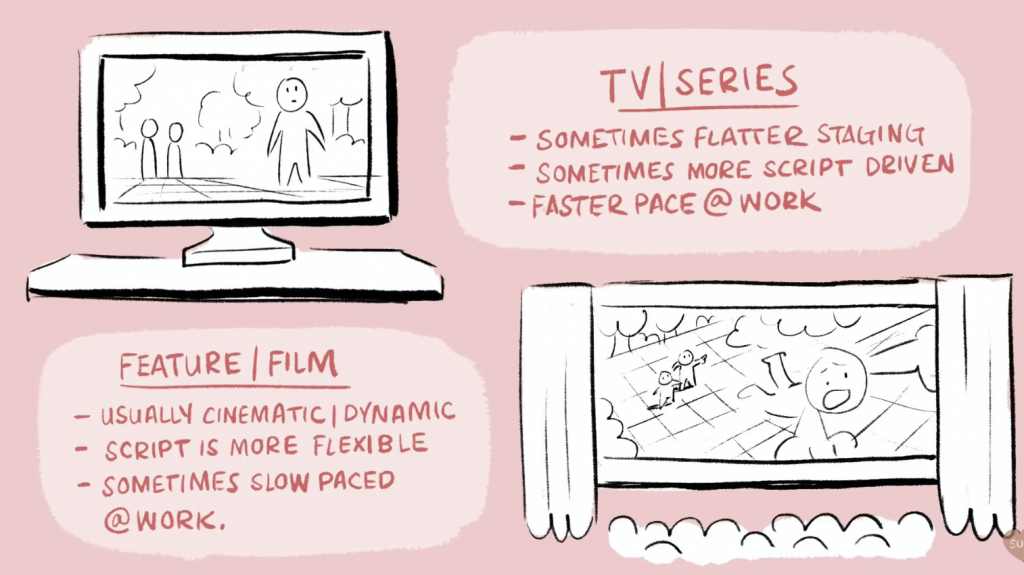
It’s better to include various story genres to demonstrate your ability to handle different types of projects. Keeping updating the portfolio when working in the industry, it’s helpful for applying next job. (StoryboardArt, 2025)
- Comprehensive Skills
As I mentioned, boarding is like a foundation of the project. Besides good technical ability, storytelling and film language are also key. In this stage, the goal is narrating sequential story clearly, not producing the polish drawings.
- Being Adaptive
Directors may shift ideas quickly, so there will be many changes . In different projects, storytelling needs, visual expectations and directors’ styles are different. Regular discussions are necessary.
- Passion and practice
Reading and watching cinematography is helpful. While watching films, we can focus on its camera and stage, and then draw the shot change (mewTripled, 2020).
Knowing the key skills will do on the job is necessary. Mastering the tools, such as Photoshop and ToonBoom etc.
Workflow
- Taking a script and break it down. Most of time, artists only need to visualize the scripts. When there is only a paragraph to explain, they should explore and write the dialogue. (Roman, 2025)
- Thumbnails allow artists do the experiment and brainstorm without too much labor. Making it small, fast and easy to draw. (Toniko Pantoja, 2025)
- When boarding, artists should make sure the design loose and clear. It’s helpful to write the basic idea of a scene design. Since adjustments can happen at any time, it’s important to have a clear mind. (Toniko Pantoja, 2025)
- Revisions
Many storyboard artists talked about their journey in industry, they usually started fixing the completed boards as a revisionist. It’s a stage to show others you have ability to become a storyboard artist. Once they are confident in their comprehensive skills, they have potential to move up to the director. As a director, they still need to work on boarding and revisions (), and the previous experience let them achieve a good outcome.
For me, storyboarding is interesting, but also struggling. However, I believe it is a valuable skill even in other roles.
Bibliography
Animation Story Group (2019) What is a Storyboard Artist? [Animation Story Group]. 11 February. Available at: https://www.youtube.com/watch?v=Lxn3aASFZGw (Accessed: 23 Nov 2025).
mewTripled (2020) How to be a Storyboard Artist (how I became a storyboard artist) 15 December. Available at: https://www.youtube.com/watch?v=_KC5XPPC_aA (Accessed: 23 Nov 2025).
Roman, C. Everything You Need to Know About Storyboarding (from a Pixar Pro). Interview with Christian Roman. Interview by Schito, P. 25 September. Available at: https://www.youtube.com/watch?v=GaQjtGblqxQ(Accessed: 23 Nov 2025).
Sony Pictures Animation (2014) Inside Sony Pictures Animation – Storyboard Artist Patrick Harpin. 23 April. Available at: https://www.youtube.com/watch?v=7mlneY-E6ac (Accessed: 23 Nov 2025).
StoryboardArt (2022) From Storyboard Artist to Director: Design Your Storyboard Career Path. 29 June. Available at: https://www.youtube.com/watch?v=btmBFdI3xNU (Accessed: 23 Nov 2025).
StoryboardArt (2025) Want to Be a Storyboard Artist? Here’s How to Start. 7 February. Available at: https://www.youtube.com/watch?v=LShJI6m10ug (Accessed: 23 Nov 2025).